Western & Traditional Wedding Planning Guide 2026: Church Ceremony, String Quartet, Speeches & First Dance
Classic · Catholic · Civil · Contemporary — the operational details that make a traditional Western wedding run with precision.
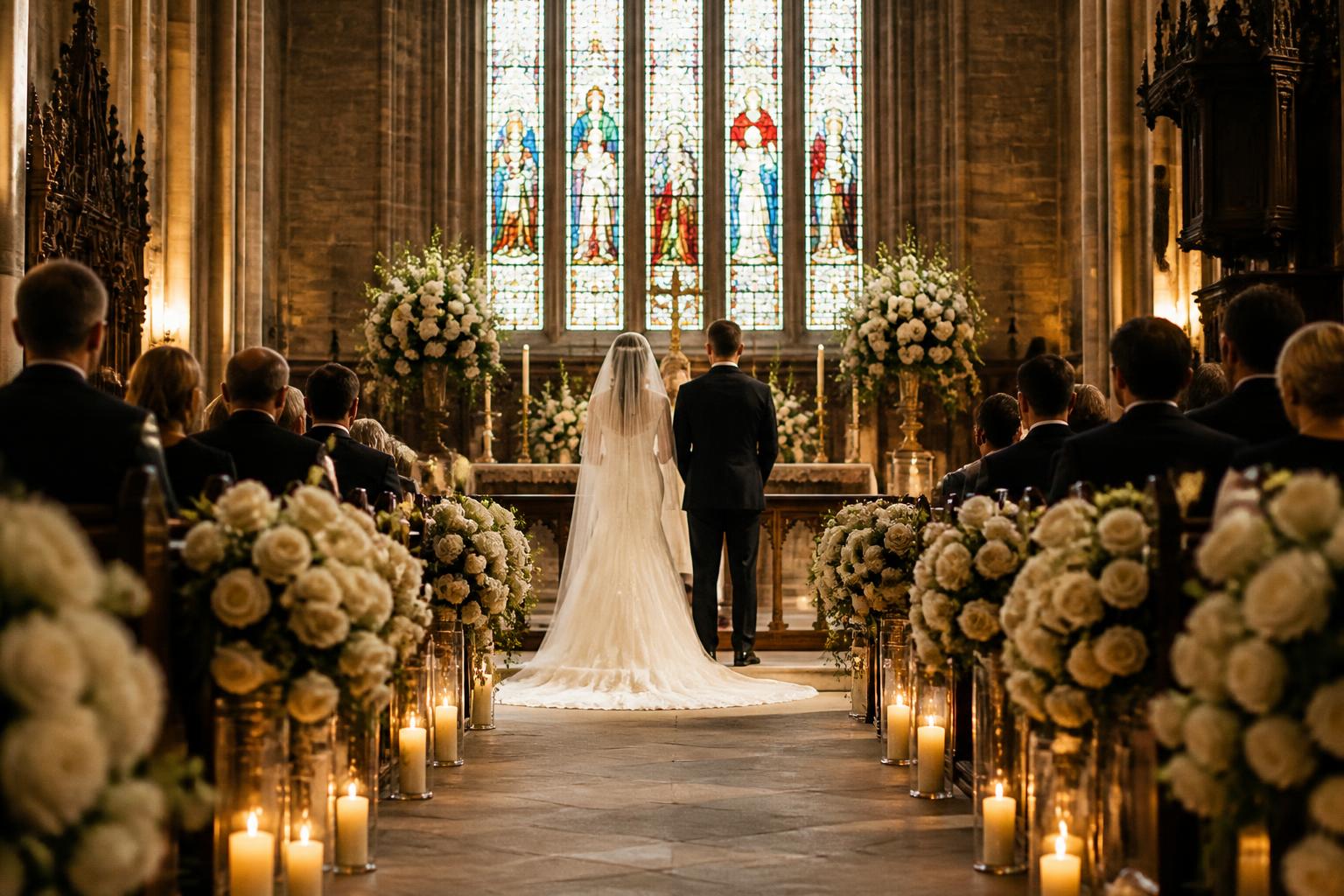
The Western wedding has a problem that no one talks about: because it is the default assumption of almost every wedding planning tool, article, and vendor, its specific operational requirements are treated as obvious. They are not. The difference between a Church of England ceremony and a Catholic nuptial mass is 45 minutes and a Communion rite. The string quartet's role at cocktail hour is categorically different from its role during the processional. The speech order has a logic that most couples discover too late, after they've already briefed their speakers incorrectly.
This guide covers the Western and traditional wedding in the same depth we bring to every other cultural tradition — not as the default, but as a ceremony type with its own specific requirements, vendor logistics, and planning decisions that deserve the same precise treatment.
The Four Western Ceremony Types — What Actually Differs
Couples often use "church wedding" as a catch-all. The practical differences between ceremony types are significant enough that choosing the wrong venue for your tradition can create real problems on the day.
Church of England / Protestant (~35–45 minutes)
The most flexible format. Music is typically unrestricted (confirm with your vicar), the order of service can be personalised within limits, and contemporary readings alongside scripture are common. Banns must be read on three consecutive Sundays before the wedding date, or a Superintendent Registrar's Certificate obtained. Pastoral fee to the church is typically £400–£600 in the UK; equivalent arrangements vary by denomination internationally.
Catholic Nuptial Mass (~60–90 minutes)
The most structurally constrained format. Both parties should be baptised Catholics; if one is not, a dispensation from mixed marriage or disparity of cult is required from the diocese — apply at least 6 months ahead. The mass includes the Liturgy of the Word (20–25 minutes alone), the Rite of Marriage, and the Liturgy of the Eucharist. Non-Catholic guests do not receive Communion and remain seated — brief them in the order of service so no one is surprised. Music must be submitted to the parish music director for approval. Secular songs are typically not permitted. Popular Catholic wedding music — Ave Maria, Panis Angelicus, Ubi Caritas — is fine. Your favourite pop song performed by a string quartet is not.
Civil / Registry Office (~20–30 minutes)
The legally simplest format. The ceremony is conducted by a registrar and contains fixed legal wording that cannot be altered. Personal vows are permitted as an addition but must contain no religious content. The ceremony itself is brief — many couples use it as the legal ceremony and then hold a separate, larger symbolic ceremony with a celebrant. Give notice at the register office at least 28 days before the ceremony (UK); equivalent requirements in Canada and the US vary by province/state. Marriage certificate is issued immediately on the day.
Contemporary / Garden with a Celebrant (~40–50 minutes)
The fastest-growing format globally. An independent celebrant creates a fully bespoke ceremony — no fixed liturgy, personal vows, secular readings, any music, any venue. The legal component is handled separately (civil ceremony at the register office, or the celebrant obtains a licence if jurisdiction permits). The creative flexibility is total: unity candles, ring-warming ceremonies where the rings are passed through the entire congregation, guest-participation moments, multimedia elements. The rehearsal requirement is higher than for a structured ceremony precisely because the format has no default scaffold.
The String Quartet — Deployment Logic
A string quartet is not an ambient music system. It is a sequence of precisely cued musical performances that correspond to specific ceremony events. The most common mistake: booking a quartet for "the ceremony" without specifying which moments and what music for each.
| Moment | Duration | Musical Direction | Key Logistics |
|---|---|---|---|
| Prelude (guest arrival) | 30–45 min | Background classical — Vivaldi, Bach, light contemporary arrangements | Quartet plays continuously; guests talk over it; that's correct |
| Wedding party processional | 3–5 min | Steady tempo, 60–70 BPM — Canon in D, Trumpet Voluntary | Must be able to loop if party walks slowly |
| Bride's processional | 1–3 min | The emotional peak — begins on cue signal, not on a timer | Agree a physical cue with the coordinator: a nod, a hand signal |
| Register signing interlude | 2–4 min | Emotionally warm — contemporary arrangement acceptable here | Duration depends on how long signing takes; quartet improvises length |
| Recessional | 3–5 min | Joyful, 90–120 BPM — Mendelssohn, Ode to Joy, upbeat arrangement | This is a celebration — energy should visibly increase |
| Cocktail hour | 60–90 min | Background at conversation level — mix of classical and popular arrangements | Stationed or strolling; no amplification needed for rooms under 150 guests |
🎻 The single most important briefing: the bride's processional cue. The quartet must not start when they hear doors open or when they see movement. They must start when they receive an agreed signal from the coordinator. Many processionals begin awkwardly or too early because this cue was never established. Fix it at the rehearsal.
Speech Order — The Logic Behind the Sequence
The traditional Western speech order is not arbitrary. Each speaker has a specific relational role and a specific purpose that places them where they are in the sequence.
The father of the bride (or family representative) opens because they are acting as host on behalf of the family that is giving away a member. They set the welcome tone and make the first formal acknowledgment of the occasion. The best man follows because his role is to represent the groom's side and to handle the practical business of thanking the bridesmaids and toasting the couple. The groom speaks third because he is the person who has the most to thank everyone for — and because speaking after the best man allows him to respond to whatever was just said. The bride speaks last, if she speaks, because it is increasingly the convention that the day ends with her voice.
Timing That Actually Works in 2026
The traditional placement of speeches after the main course is dying for a reason: guests are full, tired, and a significant percentage have had several drinks. Attention is not at its best. The modern alternative — speeches after the starter is cleared, before the main course — keeps energy high, keeps guests attentive, and means the rest of the evening can flow without the weight of pending speeches.
| Speaker | Target Length | Core Content | Common Mistake |
|---|---|---|---|
| Father of the bride | 4–6 minutes | Welcome, family memories, toast to couple | Too long, too many anecdotes, no structure |
| Best man | 5–7 minutes | Groom stories, thank bridesmaids, toast | Inappropriate content, going over 10 minutes |
| Groom | 4–6 minutes | Thank families, toast bride and bridesmaids | Reading from phone with no eye contact |
| Bride | 3–5 minutes | Personal perspective, thanks, love | Deferring to groom's speech content, saying the same things |
First Dance — What the Choreographer Needs
Booking a first dance choreographer without a brief wastes the first session. The choreographer needs to know: the song and its structure (does the tempo change? does it build? is there a key change?), both partners' real dance experience (not "we're pretty good" but "we've had 0 / 2 / 10 previous dance lessons"), how much time is available for practice, and any specific moments the couple wants (a surprise dip, a spin, a moment where the bridesmaids join).
A useful framing for the choreographer: what level of impression do you want to make? There are three honest answers:
- Look comfortable: 3–4 sessions, basic footwork, look like you've done this before. Achievable from zero for almost any couple.
- Look polished: 6–8 sessions, style and musicality, guests applaud genuinely. Requires some natural rhythm or prior experience.
- Look impressive: 10+ sessions, specific technique, possibly a performance element. Requires commitment and genuine aptitude.
Most couples aim for "look polished" and have time for "look comfortable." The choreographer will tell you honestly where you are after the first session. Trust that assessment.
Fusion Western + Cultural Ceremonies
A growing proportion of Western weddings are fusion ceremonies — one partner from a Western background, one from South Asian, Chinese, Persian, Jewish, Mexican, or Southeast Asian tradition. Weddings.io covers all of these combinations through the culture-specific tool pages linked below.
The operational principle for any fusion ceremony: treat it as two complete ceremonies being interlaced, not one ceremony with additions. Each tradition has its own ritual logic, its own spatial requirements, and its own emotional register. A Hindu ceremony that follows immediately after a Western ceremony in the same venue without a clear transition feels like an afterthought. Build a genuine transition — a musical change, a brief MC introduction, a physical repositioning of the couple and guests — that gives each tradition its own context.
Costs in 2026 — Traditional Western Wedding (200 guests, Canada/UK)
| Category | London (UK) | Toronto (CA) | Vancouver (CA) |
|---|---|---|---|
| Venue + catering | £18,000–£40,000 | $22,000–$45,000 | $20,000–$40,000 |
| Photography + video | £3,500–£8,000 | $4,000–$10,000 | $3,500–$9,000 |
| String quartet (ceremony + cocktail) | £1,200–£2,200 | $1,400–$2,400 | $1,000–$2,000 |
| DJ or band (reception) | £1,500–£4,000 | $1,800–$5,000 | $1,500–$4,000 |
| Florals | £2,000–£6,000 | $2,500–$7,000 | $2,200–$6,500 |
| Bridal attire | £1,500–£6,000 | $2,000–$7,000 | $1,800–$6,500 |
| Celebrant / church fee | £400–£1,200 | $500–$1,500 | $500–$1,200 |
| First dance choreography | £400–£1,200 | $500–$1,400 | $450–$1,200 |
Free Western Wedding Planning Tools
Church ceremony type guide, string quartet scheduler, speech order planner, first dance choreographer brief, and traditional wedding checklist — all free at Weddings.io.
Open Western Wedding Tools →