Persian Wedding Planning Guide 2026: Sofreh Aghd, Aghd Night & Iranian Traditions
عروسی · The complete planning guide for Iranian and Persian weddings — all 14 Sofreh Aghd items, two-night logistics, live music, and what every vendor needs to know.
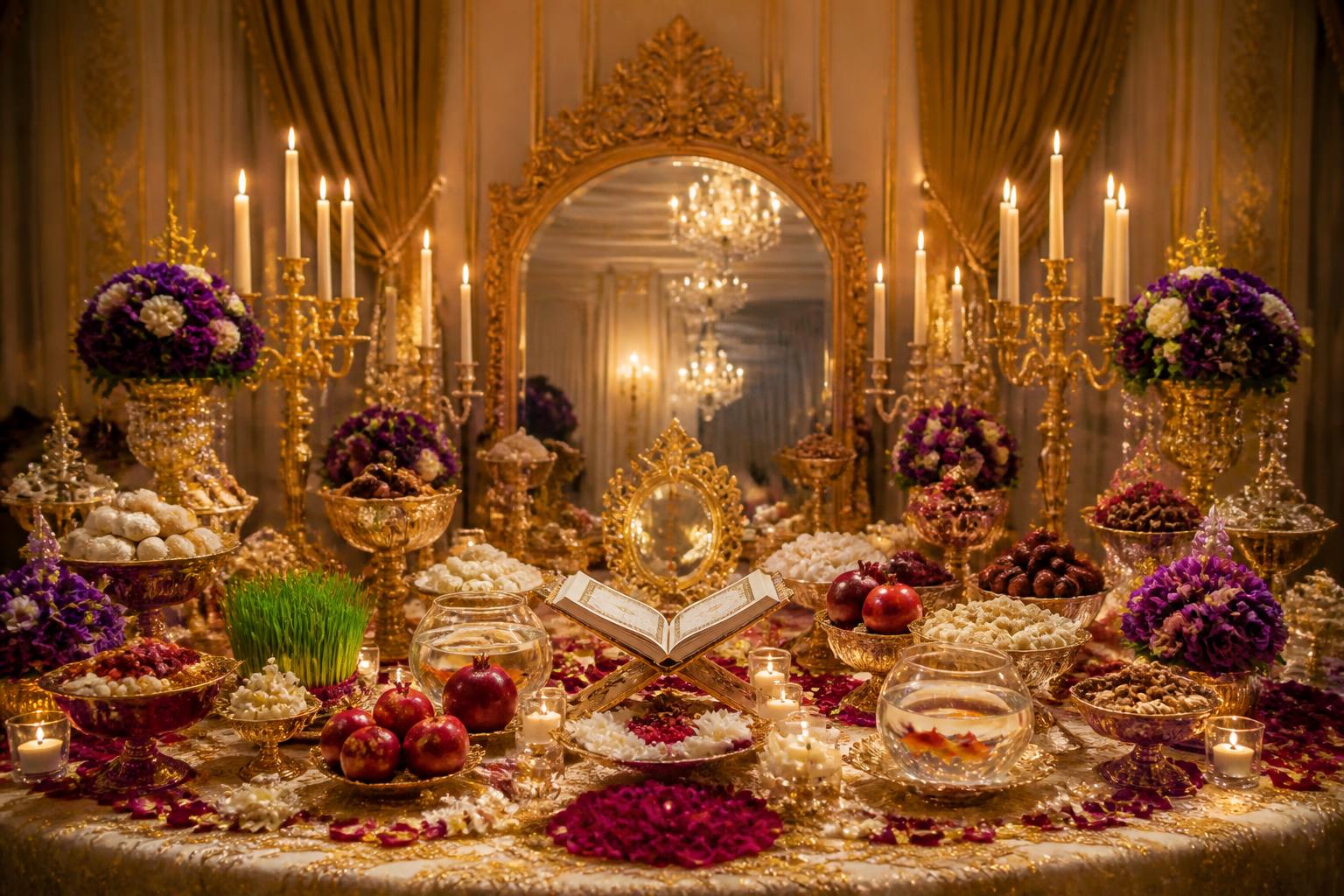
Iranian weddings in the diaspora — in Toronto, Vancouver, Los Angeles, London, and Sydney — carry a weight that goes far beyond the celebration itself. They are acts of cultural preservation. Families who left Iran in the 1980s or 1990s raise children who have never seen the country, and the wedding becomes the most concentrated expression of everything that was carried across borders. The Sofreh Aghd is not décor. It is a document of identity.
This guide covers the full architecture of a Persian wedding: what every item on the Sofreh Aghd means and why it is placed where it is, how to structure a two-night wedding, which musicians to book for which moments, and what the calligrapher needs to produce work that honours the occasion.
The Sofreh Aghd — All 14 Items Explained
The Sofreh Aghd (سفره عقد) is the ceremonial spread at the heart of the Aghd ceremony. It is set on a fabric of silk or velvet, laid flat on the floor or on a low table, facing East. The couple sits before it facing each other. Every item has been placed with intention — nothing on a Sofreh Aghd is random.
🌹 The Sofreh Aghd is assembled by the bride's mother and female family members, typically beginning the morning of the Aghd. It is not something to delegate to a venue or décor company unfamiliar with Iranian customs. Every item has a specific placement relative to the mirror. The mirror faces East.
Aghd Night vs. Aroosi — Two-Night Architecture
Many Iranian families in the diaspora split the wedding across two separate evenings. This is not a compromise or a cost-saving measure — it is the traditional structure that allows each ceremony to breathe at its correct pace.
The Aghd (عقد) — Evening One
The Aghd is the legal and religious marriage ceremony. It is conducted at the Sofreh Aghd by a mullah, rabbi, or civil officiant. Guest count is typically 50–150, limited to close family. The ceremony itself takes 60–90 minutes and includes the Bale goftans (the three "yes" moments), the reading of the Mehrieh (bride's dowry in the marriage contract), signing of the Aqd Nameh, the needle-and-thread ceremony, the Kalleh Ghand grinding, and the honey exchange.
The Aghd evening ends with dinner served to family — Persian rice (chelou), khoresh, and a dessert spread. It is intimate by design. The emotional register is high.
The Jashn-e Aroosi (جشن عروسی) — Evening Two
The Aroosi is the celebration. Full venue, 200–500 guests, live Persian band or DJ, elaborate dinner, and dancing from 8pm to 1am or later. The couple makes a grand entrance — often to live tar and tombak — and the evening builds from formal dinner through speeches into open dancing. The tonal shift from Aghd to Aroosi is intentional: the gravity has been honoured, now the joy is given full permission.
Some families hold both ceremonies on the same day — Aghd in the afternoon, Aroosi in the evening at the same venue. This is more common in Iran itself and in communities where guests are travelling from far away. The two-day structure is more common in Toronto, Vancouver, and Los Angeles where extended family is local.
Persian Live Music — Which Instruments for Which Moment
Persian classical music has a vocabulary of instruments that each serve a different function in the wedding day. Booking the right combination for each segment is what separates a Persian wedding that feels authentic from one that feels culturally approximate.
| Instrument | Character | Best Used For |
|---|---|---|
| Tar (تار) | Long-necked lute. Deep, soulful, emotionally complex. | Aghd ceremony, cocktail hour, first dance |
| Santur (سنتور) | Hammered dulcimer. Bright, shimmering, cascading. | Aghd background, dinner music, first dance |
| Tombak (تنبک) | Persian goblet drum. Precise, rhythmic, drives energy. | All dancing, Aroosi reception sets |
| Kamancheh (کمانچه) | Spike fiddle. Haunting, lyrical, emotionally piercing. | Ceremony, bride's entrance, emotional moments |
| Daf (دف) | Frame drum with jingles. Communal, celebratory. | Processional, Sufi-influenced ceremonies |
| Persian DJ | Googoosh, Dariush, Shahram + modern Persian pop + Western mix | Post-midnight dancing |
The Persian Calligrapher
A Persian calligrapher is not simply someone who writes beautifully. They are producing documents in one of the oldest and most refined calligraphic traditions in the world. Nastaliq (نستعلیق) — the dominant Persian script style — has been in continuous use since the 15th century and is structurally different from Arabic calligraphy in its flowing, diagonal rhythm.
A Persian calligrapher is needed for: wedding invitations (100–300 pieces), the Aqd Nameh (marriage contract) decorative border, Sofreh Aghd scroll with prayers or Hafez poetry, seating cards in Farsi and English, and menu cards for formal dinner tables.
Rates in Toronto and Vancouver range from $800–$3,000 depending on quantity and complexity. Book at minimum 3 months ahead — skilled Persian calligraphers in diaspora cities are genuinely scarce and book out quickly for spring and fall wedding seasons.
Persian Wedding Costs in 2026
Persian weddings in Canadian and American diaspora cities are consistently large, elaborate, and expensive relative to the baseline. The Aroosi in particular — with live music, elaborate florals, and Persian catering for 300+ guests — is not a budget event.
| Category | Low | Mid | High |
|---|---|---|---|
| Aroosi venue + catering (300 guests) | $25,000 | $40,000 | $80,000 |
| Live Persian band (5-piece) | $3,500 | $6,000 | $12,000 |
| Sofreh Aghd styling | $1,200 | $2,800 | $6,000 |
| Photography + video (both nights) | $4,000 | $8,000 | $18,000 |
| Florals (both nights) | $3,000 | $7,000 | $15,000 |
| Bridal attire (Aghd + Aroosi) | $3,000 | $6,500 | $14,000 |
| Calligrapher + stationery | $800 | $1,800 | $3,500 |
| Total (two-night) | $40,500 | $72,100 | $148,500 |
Free Persian Wedding Planning Tools
Sofreh Aghd 14-item checklist, two-night planner (Aghd & Aroosi timelines), calligrapher brief generator, and Persian live music scheduler — all free at Weddings.io.
Open Persian Wedding Tools →